Your cold plunge just made you weaker

Aaron Houghton
Okay, hang on, calm down, I love a good cold plunge as much as the next wellness influencer. This is a picture of me in Boulder Creek in Boulder, Colorado in an ice hole in January. I get it.
But here’s the thing. I cold-plunge because it’s part of my personal optimization routine, which I think everyone should have.
But is it working?
Psychologists say that emotion follows action, and I know that there’s an optimized version of my mindstate where I feel brilliant and everything becomes effortless.
And unfortunately, I also know that there are few other versions of my mindstate where I feel awful and get angry easily and produce crappy work.
So I want to take action and do things that will move me toward an optimized mindstate as much as possible, because it just feels better and because I create incredible things when I’m there.
In fact, I think that’s what we all want.
But that’s where cold-plunging makes us weaker, because doing the same thing every day in the midst of constantly changing external situations and a constantly changing internal mindstate is like putting an ice pack on your left elbow every day when one day your ankle is swollen, and the next day it's your knee.
You’re using a smart solution to solve the wrong problem.
General recommendations are just that. They generally work for some group of people some of the time. If you apply general solutions to specific problems, you will sometimes improve.
And that’s good enough for most people.
But for the high-pressure high-achievers I’ve been studying for over a decade now, we need more. We need more speed and more precision because we don’t have the time to run a five-hour recovery protocol every day, just hoping there’s enough impact in there somewhere to support us where we need it most.
It’s not our fault. We’re using a good solution to solve the wrong problem because we lack the precision to correctly understand the problem. Because, until now, the tools didn’t exist.
Your cold plunge didn’t make you dumber by reducing your intelligence, it made you dumber because it shifted you away from your optimized mindstate and your performance today will now suffer as a result.
You tried to improve yourself but you made everything worse. How frustrating.
Despite a decade of studying myself and other high-achievers I’m not immune to these types of mental mistakes in my own life. This is a classic situation where our intuition gets us in trouble.
Over the last five years I’ve cold-plunged over 100 times and every time I did it I recorded how I felt using a tool I created to track changes in my mindstate. In that exact moment, coming out of the water, just after catching my breath and regaining my focus, I capture the status of my mindstate so I have the data to prove to myself what’s actually happening on the inside.
I always feel great afterwards. I’m proud of myself for doing something that my mind resists. I enjoy the connection with my friends when we complete the challenge together. And I can tell that something is changing within me because my body reacts in multiple ways at the same time.
But for me, is cold-plunging just entertainment, or is it optimization?
So today I put myself to the test. Opening my tracking system, I answered some questions about my current mindstate, then I selected my beloved cold plunge play, packed full of data about how it's shifted my mindstate over 100+ experiences in the past.
Without actually doing a cold plunge, I guessed the factors of my mindstate that would be most likely to improve if I did a cold plunge right now.
I selected focus, positivity, energy, and personal identity as my expectations.
Assuming that the challenge of retaking control of my breath would build my focus. The surge of endorphins would bring energy and make me feel more positive. And that knowing I had taken an action to be my best self would support my belief in the strength of my identity as a healthy person.
But do my assumptions align with reality? Here’s the data.
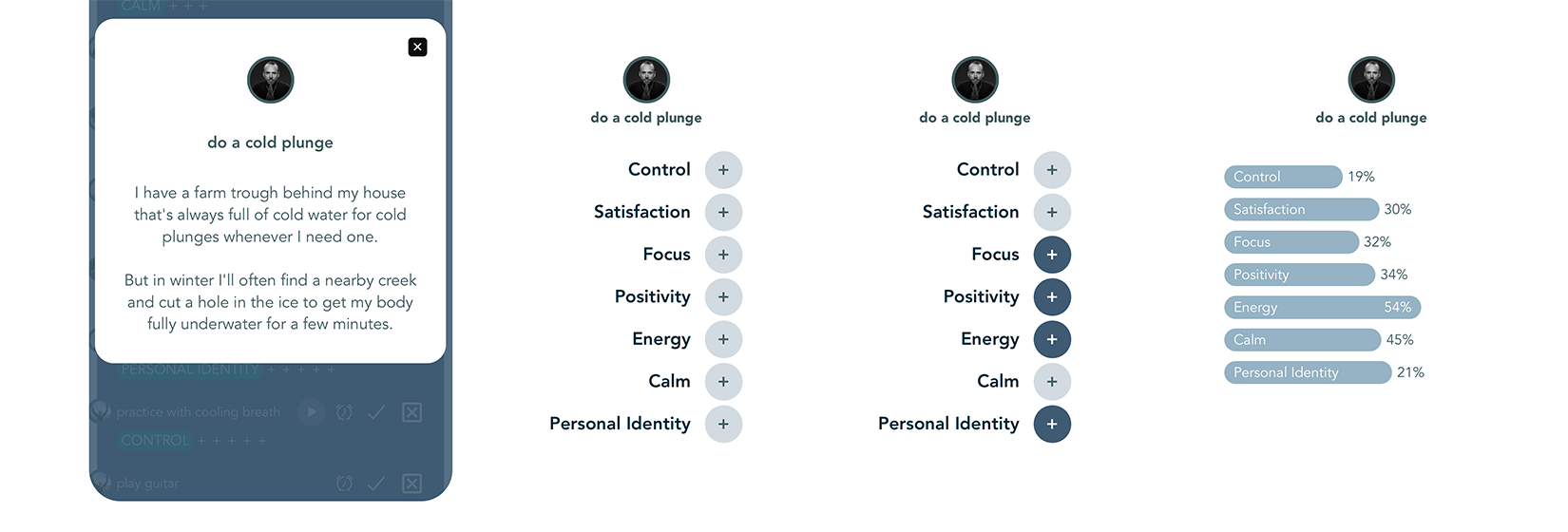
I got energy right. I felt more energy 54% of the time when I cold-plunged in the past. In fact it’s the only emotional factor that improves more than half the time when I cold plunge. Something I can potentially rely on in the future when I need more energy.
I feel more positive 34% of the time, a decent assumption but not nearly as strong as calm which I noted feeling 45% of the time when I cold-plunge. I entirely missed the impact on calm in my guesses.
Focus comes in fourth at 32%, and it made my list of four guesses so I got that one right.
Then there was my guess of personal identity, which according to the data at 21%, was way off the mark, coming in second to last of all seven factors of my mindstate when I cold-plunge.
So I missed the large impact on calm, and I incorrectly guessed personal identity. My intuition got about half of my four guesses correct. Fifty percent accuracy, despite my best attempts at tracking my mindstate through a hundred cold plunges in the past.
And I’m going to go out on a limb here and guess that most people aren’t as intense as I am and don’t specifically measure changes in their mindstate every time they get out of cold water.
Despite my best attempts at mentally programming my optimization routine over years, my intuition was still only half right. Which means it was also half wrong.
Which means that half the things I intentionally put into my active recovery protocol based on intuition alone, are wrong. Which means that half the time I spend trying to restore my mind based on what I think works, goes to waste, if I do it by intuition alone.
There are many people in this world who can spend half their non-work time doing things that don’t correctly support and restore their mindstates, but high-pressure high-achievers don’t have this luxury.
The constant stress and pressure. The constant intensity and busyness. These are the realities that demand us to use data and tools, instead of intuition, to make ourselves better.
Precise recovery programs are a key component of the scientifically proven Optimal Pace Protocol that we teach here at Dory, the other half is precision pacing, the correct scoping of our work effort over time.
Just like elite athletes train and recover with intentionality and measurements, the Optimal Pace Protocol allows mental athletes, people like us who work with our minds, to go bigger, push harder, and achieve more while precisely matching our recovery power to our exertion strength so we never ever burn out.